
The challenge
Under UK trade union law, industrial action ballots must hit a 50% turnout threshold and right now they still have to be run by post. That means unions are working against a hard deadline, with no official data on where turnout stands until the result lands. The only way to track progress is to ask members directly: have you posted your ballot paper back?
For many unions balloting tens of thousands of members across multiple employer groups, the maths is stark. Around 40–45% of members will vote without much prompting; they're engaged, they've voted before, and they'll do it again. The ballot is won or lost on the remaining 5–10%. Finding and reaching those people in time is the whole game.
"We know that in most ballots, 40 to 45% of our members will vote pretty much for anything, all the time. It's that 5 to 10% that we need to get over the 50% threshold — and that's where the really crucial additional comms and messaging come in to try and squeeze that."
The old way
Without a fast way to separate early voters from the undecided, activists were spending time chasing members who'd already posted their papers days ago. Email and social media could reach people but generated no structured data back. Workplace conversations were effective but slow and unscalable. The result: unfocused effort during the most time-pressured weeks of the campaign.
How unions do it with Movement
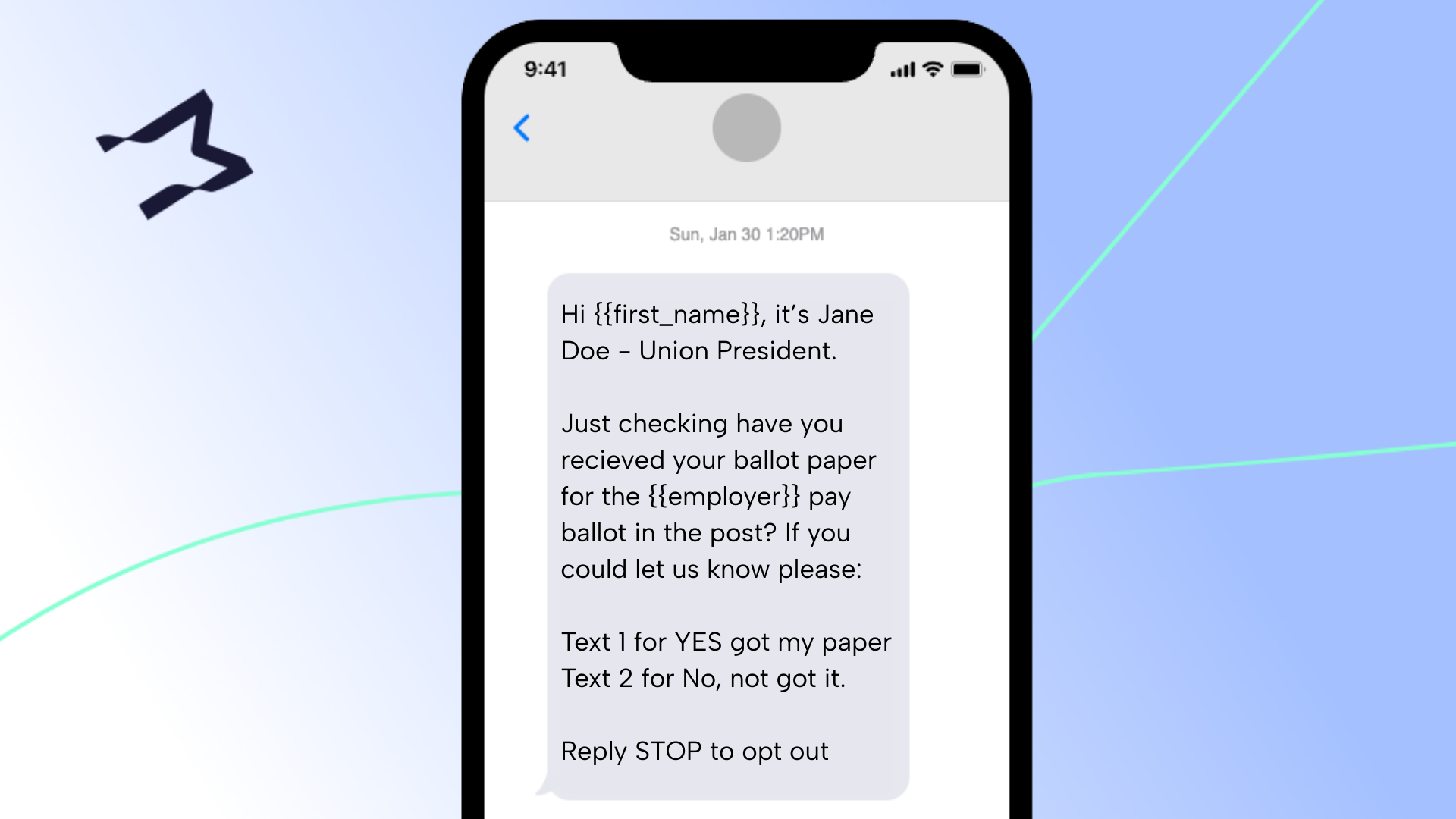
The approach is deliberately simple. On day one of each ballot, the union sends a mass SMS blast to the entire electorate. In one recent campaign, that meant 30,000 texts in a single day. The message asks one question: have you posted your ballot paper? Members reply with a single digit — 1 for yes, 2 for no — and their response feeds straight into Movement's survey system.
Members who confirm they've voted are immediately banked. They're pulled out of all further contact — no follow-up texts, no phone calls, no workplace conversations about the ballot. They're done.
"The first round of text messaging is basically just a blast out. It's a really crude tool. We don't do nice follow-ups, we don't do multiple questions. It's literally: who are the early voters? Tell us you've voted. We can just move them to one side and almost forget about them."
What's left is a dramatically smaller, more focused list. The union can now see exactly where they stand — not just overall, but broken down by branch and employer group. If the Glasgow branch is at 30% on day two but Birmingham is at 5%, that intelligence shapes where resources go next.
"All that information is coming back into us as well. We can marry up the branches and see where we've got problems with low turnout. That helps us do targeted work and say, OK, what's going on there — we need to put some people in."
From here, the union escalates through more targeted channels. Text follow-ups go to non-responders. Phone bank campaigns are spun up for the hardest-to-reach segments. Local reps have workplace conversations with members who haven't engaged through any digital channel. Each layer is more resource-intensive, but each is focused exclusively on the people who still need reaching.
"The texts always give us better results than the calling, but the phone calls can help target your hardest-to-reach audience. You kind of want to almost leave the people who have voted yes before — we know they're engaged. We always try to get the hardest segment of members to start with."
The union also uses SMS in the lead-up to replacement ballot paper deadlines. Because members must request replacements themselves, the union texts direct links to the form and guides them through the process — squeezing every possible vote out of the postal system.
"We'll use text messages to send the links to the form, guide them through the process to try and squeeze every single potential ballot paper and vote out of the process that we can."
The results
In a recent ballot covering around 6,000 members, one union was tracking very close to the line before the final round of SMS and phone bank activity pushed them over — finishing at 52.3%.
"They were really close, but they got over the 50% — and I don't think they would have got that without the texting and particularly the last round of calling stuff at the end."
"I'm not saying that Movement's winning us every ballot overwhelmingly. But when it's close, and it's that 1 or 2 percentage points that could really make all the difference — every ballot we win, the more things we can get for members."
The union is now preparing for what could be their biggest challenge yet — an industrial action ballot covering around 400,000 members, all by post. The same playbook applies, just at a scale where each percentage point represents thousands of people.
"I can't see us ever getting over 50% without using Movement."
Features used: SMS · Surveys · Audience segmentation · Phone banking