
Every level has its own campaign HQ
Every party has members who would happily do more if someone asked. Most of them never get asked. Progressive parties across Europe use Movement to put campaigning tools in the hands of branch secretaries and club leaders. Locals talk to their own members, all year round, and grow the activists who keep a party going between elections.
This is how they do it, from the branch up.
The problem with a membership list
A membership list is a list of names. It won't tell you who is itching to help, or who would chair the local club if somebody else brought the biscuits.
Meanwhile opt-in laws and screened calls make voters harder to reach every year, so parties are back on the doorstep. Doors need people. Your members are your canvassers, your callers and your future candidates, and the tools you give them become the engine room of the whole party.
Building the capacity, step by step
Most parties don't start with a buzzing club on every high street. They start with a membership list and a lot of quiet. This is how Movement helps turn that into campaigning capacity, and what the platform is doing at each step.
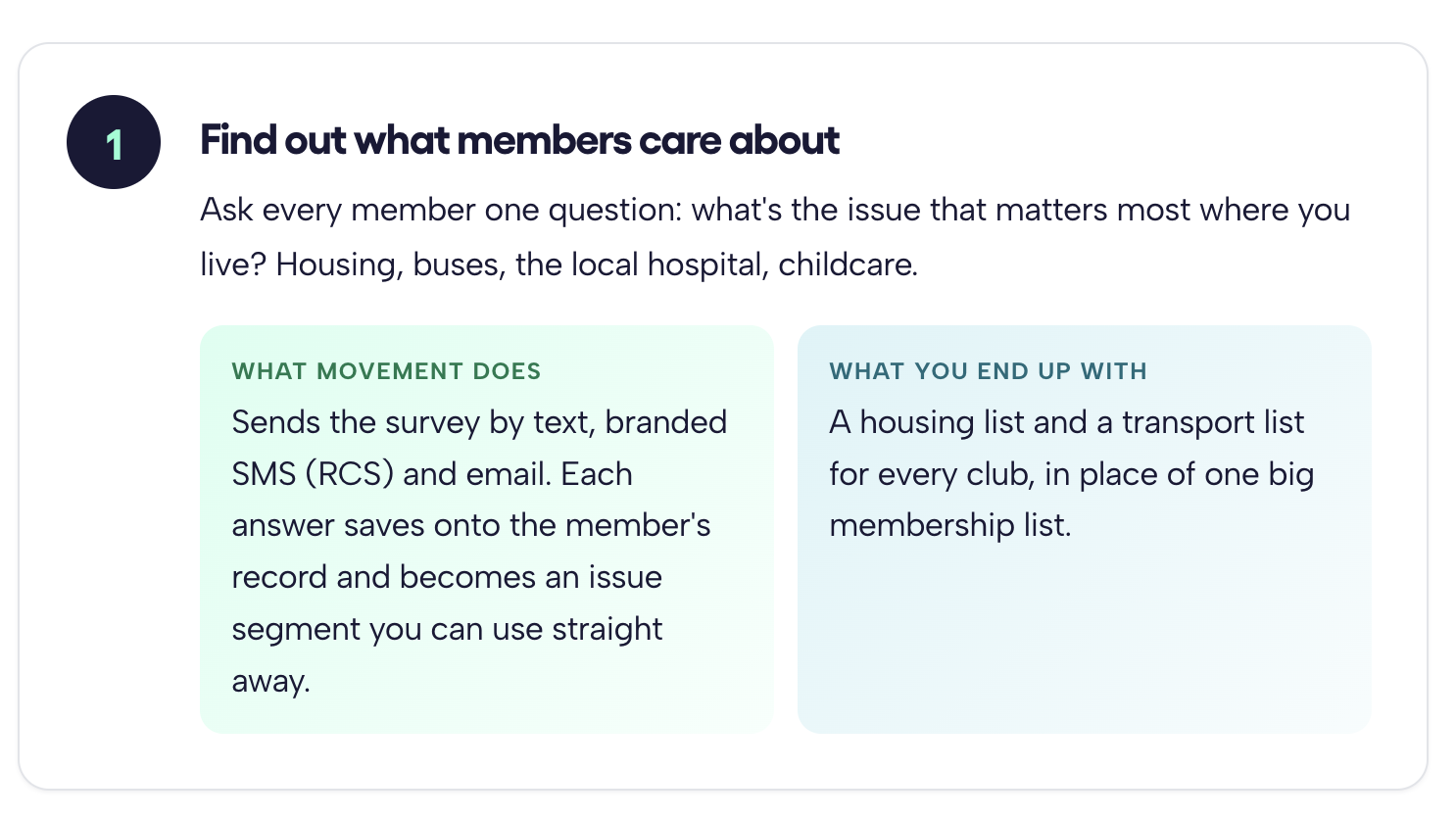
Find out what members care about
Ask every member one question: what's the issue that matters most where you live? Housing, buses, the local hospital, childcare.
Sends the survey by text, branded SMS (RCS) and email. Each answer saves onto the member's record and becomes an issue segment you can use straight away.
A housing list and a transport list for every club, in place of one big membership list.
Campaign on the issue to find your activists
Give each issue segment something to do. Come to a meeting about the hospital, or ring other members who care about the same thing.
Sends the ask to the right segment in the right area and records who takes action. Those people drop into a live audience of campaigning activists.
Activists you found by what they actually did. They already care about something specific, which makes the next ask easy.
Build a team of casework callers
Some members raise a problem of their own, like a housing repair that never happened. Trained volunteer callers ring them back, listen properly and connect them to the right local rep or councillor.
Builds a phone bank from members who flagged a problem. Callers follow a script and record every call outcome. A follow-up task gets logged against the member so nothing is dropped.
A crew of experienced callers who are good at real conversations. Members who got help remember who helped them.
Pair experienced people with new ones
Capacity spreads person to person. The people who have done it once are the best teachers.
- Club to club. An active club secretary mentors a new or quieter club nearby. They plan the first phone bank together, and the active club's callers join the first shift to show how it's done.
- Old hands to new ones. Experienced casework callers sit alongside new volunteers for their first few shifts, and seasoned organisers coach new club secretaries through their first campaign.
The region shares a campaign that worked in one club with the new club, so mentor and mentee start from something proven. Volunteers from both clubs can be invited to call on it. The region can also see which clubs have run campaigns lately and which have gone quiet, so it knows where to send a mentor.
Hand over the keys, then go again
After a campaign or two, the new club gets its own admin access and starts the cycle with its own members. A year later, it is mentoring the next club along.
Gives each new leader access mapped to their club and synced with your membership system, so they have the right tools and the right members from day one.
One active club grows the next
Power lives locally
Most parties are built like a family tree. Head office at the top, then regions, then branches or local clubs on every high street. Most party tech only works for the top of the tree.
Movement mirrors your structure from top to bottom. Every level gets the same tools for its own patch, and head office can share campaigns and audiences down to whoever needs them.
Every level runs its own campaigns and shares them down
What a branch secretary can do on a Tuesday night
Once a club is up and running, its secretary can do pretty much anything head office can do, for their own patch. No ticket to the comms team. No waiting until after the national campaign.
Email their own members
- Start from a template head office has shared, then add the local news in a powerful block email builder.
- Send in the group's name, to the group's members. Nobody else's list gets touched.
- See who opened and clicked, so the secretary knows who is paying attention.
- AGM notices and other constitutional sends go out from a dedicated set of statutory templates, so every member gets them.
Run their own phone bank
- Pick who to call. Every member in the patch, or just the people whose membership is about to lapse.
- Write a short script with a few questions. Every answer saves straight onto the member's record.
- Start making calls. They log in and call from their browser, wherever they are.
- Read the results at a local and national level. Who answered, who wants a call back, who said they'd help, who has moved house.
SMS and branded SMS (RCS)
- Peer-to-peer texts for two-way chats: a reminder about Saturday's leafleting, or a quick "how are things?"
- RCS broadcasts and surveys for news that people actually read, plus photos and voice notes back from members.
Build their own lists
- Filter on data synced from your membership system, like join date, area or renewal date.
- Use audiences head office has shared, or save their own for next time.
Head office keeps the bird's-eye view. National can share campaigns and audiences down to any level and see what every branch and club is up to. Each person logs in once and sees only the patch they look after.
Develop leaders among your own members, all year round
The best time to ring a member is when you don't need anything from them. That call is what makes the next ask land.
Most parties only phone members at election time, with a rota to fill and a deadline looming. Parties that check in during the quiet years arrive at the next election with the hard work already done.
What a check-in call gets you
- Members who feel noticed stay. Between elections, a friendly call might be the only contact someone has with the party apart from a renewal reminder.
- You hear what's going on locally. The bus route that got cut, or the GP surgery with a six-week wait. That's your next local campaign, handed to you on a plate.
- You find your leaders early. "Would you help at the next election?" is an easy yes in March. In the last fortnight of a campaign it's a scramble.
- Your data gets fixed. You pick up new numbers and spot people who've moved to another branch. Clean data in a quiet year means a faster rota in a busy one.
- Lapsing members come back. A chat before the renewal date beats any reminder email.
The maths is kinder than you think. Take a local group with 60 members. Two volunteers making a dozen calls each a night can ring every single member in a couple of evenings.
Do it in spring and again in autumn and every member hears a friendly local voice twice a year.
A simple rhythm for a group
| When | Who the club calls | What it's for |
|---|---|---|
| January | Last year's new joiners | A welcome, and what they'd like to do |
| March | Every member | A check-in, and what's bothering them locally |
| June | Everyone who said they'd help | A first job, like a phone bank or a street stall |
| September | Members due to renew | A thank you, so they stay |
| November | Every member | A big turnout at the AGM, and a seat on the board |
How that becomes long-term power
Power is organised people who know each other and act together. Elections come and go. Relationships stick around.
Every round of check-ins turns up a few members who want to do more. They become the leaders in the next election, and some of them run the round after that. The work spreads across more people instead of piling up on one exhausted secretary.
Keep that going for three years and the party walks into an election with:
- Volunteers who said yes months ago, already trained on the technology to speak to the wider membership.
- Local leaders who know their patch and every member in it.
- Members who pick up, because they've heard from this club before and liked it.
- A doorstep army. When it's time to knock on voters' doors, the canvassing rota fills from people the club has been talking to all along.
That's the kind of strength a party keeps whatever happens on polling day.
Five rungs from quiet member to local leader
Organisers have talked about the ladder of engagement for decades. The trick is making each rung easy to climb, and noticing when someone is ready for the next one.
- 5Local leaderRuns campaigns for their own clubMovement: local admin access for their club
- 4RegularComes back for shift after shiftMovement: campaign results, tags, attendance
- 3ActivistDoes an easy first job from the sofaMovement: phone banks and peer-to-peer texts
- 2ResponderTells you how they want to helpMovement: text, RCS and email surveys
- 1MemberHas joined, hasn't been asked yetMovement: welcome emails, synced from your CRM
The toolkit, rung by rung
1. Ask everyone a question
You can't promote people you haven't met. So the first job is to get members talking back.
- Surveys over branded SMS and email. "What would you like to do for the party this year?" takes ten seconds to answer. Every reply lands on the member's record.
- Answers become filters. "I'd help with phone calls" turns into an audience you can message tomorrow.
- A powerful block email builder for the newsletter that ends with one small ask.
"It used to take us a day to send 20,000 emails. With Movement we do it in ten minutes."
A political party using Movement
2. Give them an easy first job
A first job should be doable from the sofa with a cup of tea.
- Phone banking in the browser. Volunteers log in, read the script and click through call outcomes. No headset or church hall required.
- Peer-to-peer texting. One volunteer can hold dozens of real, two-way conversations in an evening. Survey questions sit right in the conversation so answers get recorded as they go.
- Build once, share everywhere. The national team builds a campaign and shares it down to every region and club. Locals just press go.
3. Spot the regulars
The people who come back for a second shift are your future leaders. Make sure you notice them.
- Campaign results show who keeps turning up. Every call and text sits against a name.
- Mark who came to the meeting. After an event, bulk-update the attendees so the turnout lives on their records.
- Tag your rising stars and build an audience of them. Then invite them to something special.
4. Hand over the keys
This is where parties usually get stuck. In Movement, a rising star can get admin access to their own club in minutes, with every tool from the Tuesday night list above at their fingertips.
5. Keep everyone friends
More people running campaigns means more chances to annoy a member. Movement has a few guard rails built in.
- One answered call a day is plenty. Once someone picks up, they drop out of every other calling campaign's pool for the rest of the day. Nobody gets rung by their club and then their region before lunch.
- Local numbers. Calls can come from a number matched to the member's region, so people see a familiar area code and actually pick up.
- Secure logins with single sign-on and optional two-factor authentication, so handing out access doesn't keep anyone awake at night.
Meet Sam
Sam is made up. Sam's year is stitched together from what we watch parties do with Movement week in, week out.
- JanuarySam joinsA local row about bus cuts tips them over the edge. They sign up online and get a warm welcome email from their local club the same week.
- FebruarySam gets a callThe club secretary runs a phone bank to everyone who joined over winter. A volunteer asks Sam what they care about and what they'd like to do. Sam says "buses" and "talking to people". That answer drops them straight into the club's transport segment.
- MarchSam's first shiftThe club's spring campaign needs callers. Sam logs in from the sofa, follows the script and rings 40 fellow members. A dozen of them mention the buses.
- MayThe club runs its own campaignThe secretary emails every member about the bus cuts, texts the helpers and books a street stall. Sam is there with a clipboard. The secretary tags Sam as one to watch.
- SeptemberSam steps upThe club board has an empty seat. Sam says yes, mostly because someone finally asked. They get admin access to their club in Movement that evening, and the secretary of a busier club nearby becomes their mentor for the first campaign.
- The following yearSam runs the check-insEvery member gets a friendly call in spring and autumn. Anyone close to their renewal date gets one too. Two of Sam's colleagues join after a chat by the kettle.
- Election timeSam's club is readyThe canvassing rota fills by text in an afternoon, from members the club has been talking to for years. Head office didn't have to lift a finger.
One member became a leader, and that leader is now growing more. Multiply Sam by every club in the country and you have a party that grows itself.
Why it works
Grow your party from the branch up
Movement is the CRM, communications and campaigning platform for some of the biggest charities, trade unions and political parties in the UK and Europe. We're a team of campaigners and organisers, and we'd love to help you build a bench of local leaders.
Book a demo